

Enter your distance
YOUR COMMUNITY RESULTDockside DrifterOpening voyage
You left the dock. Tighten the timing and keep the chorus alive.
Unofficial community title based on the selected result — not a canonical game ending.
 CHOICER VOICERPLAY ONLINE
Hum high and low notes, share two axes with your crew, and steer one ship through a tunnel built for beautifully short disasters.

Split the controls, find your pitch, and keep one very unreliable ship off the walls.
Choose another browser game without leaving the studio. The current game stays in the shelf.
Explore every voyage tier, compare community distances and see the complete global board.
You left the dock. Tighten the timing and keep the chorus alive.
Unofficial community title based on the selected result — not a canonical game ending.
Legendary voyage0 runs · 0%
Deep-water run0 runs · 0%
Coordinated run0 runs · 0%
Opening voyage0 runs · 0%
The board will display every verified submission here.
Upload the results screen and enter the distance shown in metres. Remove names, notifications, faces and private chat before uploading.
This is an independent browser presentation. Game facts on this page were checked against the creator's listing, and the gameplay images show the interface and voice-driven play described below.

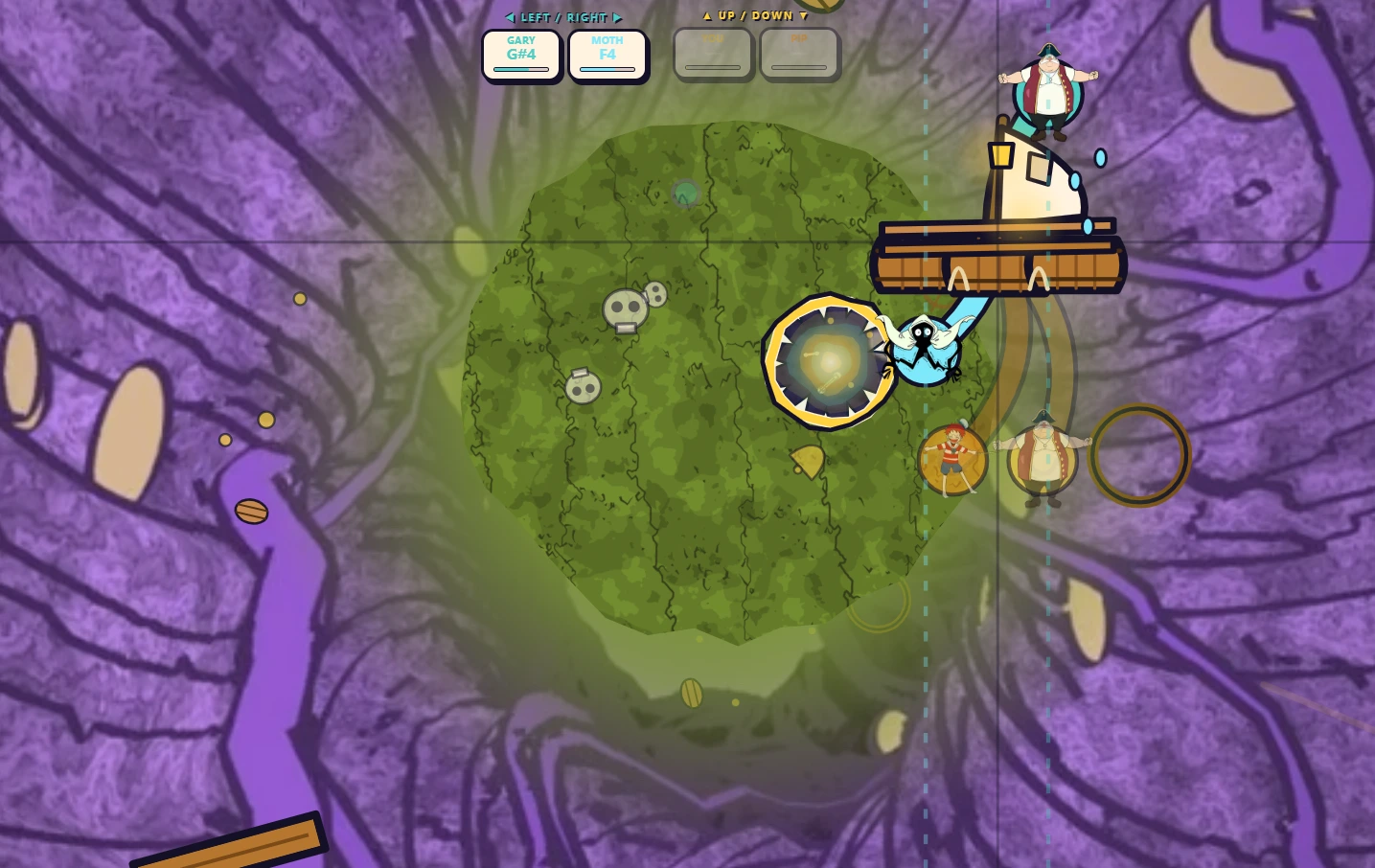
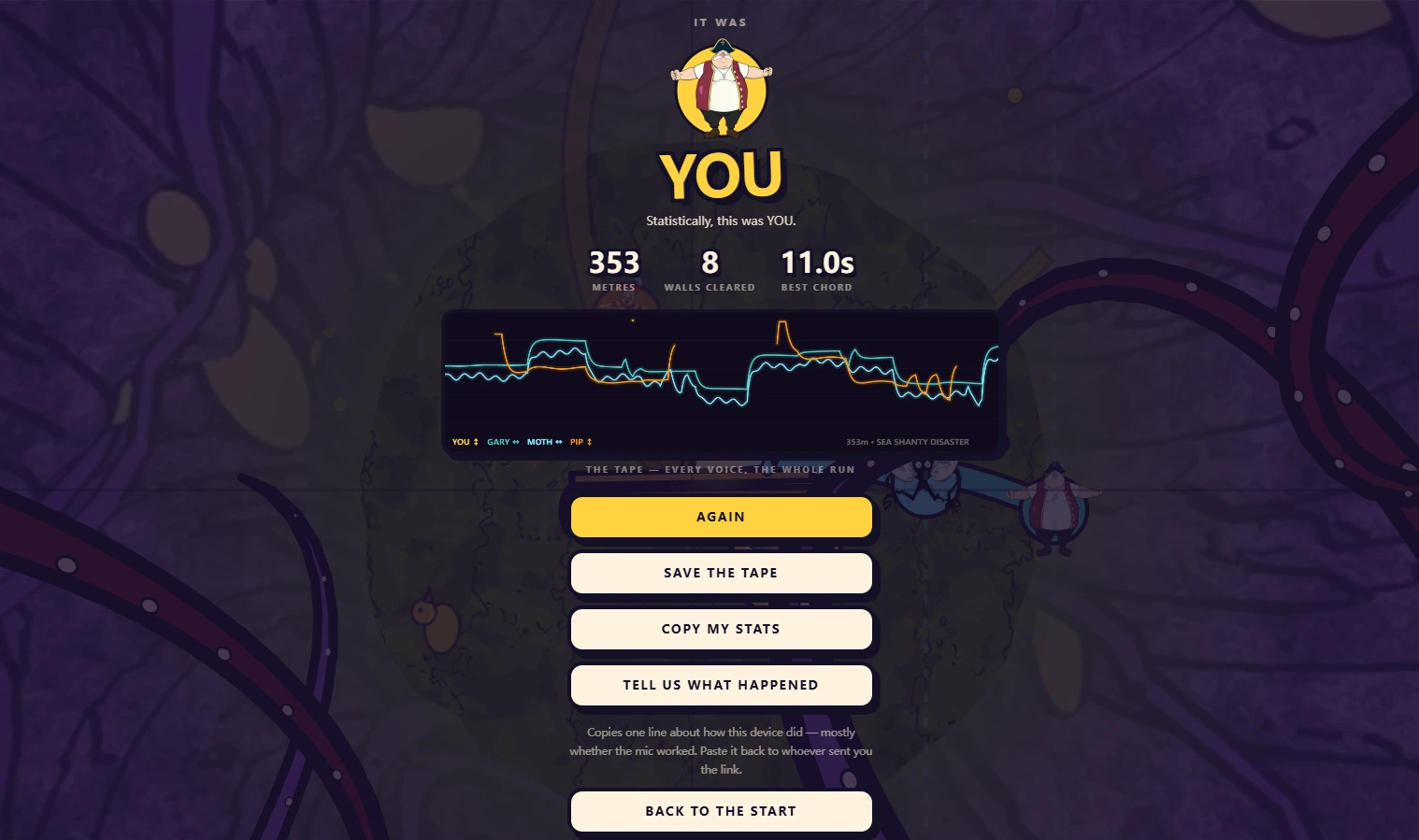
Setup, play rhythm, group etiquette, troubleshooting, and replay ideas for a smoother browser session.
Sea Shanty Disaster turns a simple tunnel run into a communication problem. Two to four players share one ship, yet the crew is divided into jobs: one side influences left and right while the other influences up and down. Low and high notes choose direction, and holding a note maintains the movement. That split is the source of both strategy and comedy. A player can perform their assignment perfectly while the ship still crashes because the other axis arrived late, overshot the opening, or reacted to the music instead of the tunnel. The design asks a group to listen, call out a plan, and accept that control is collective. Solo practice and bots make the rules easier to learn, but the distinctive experience comes from several people trying to coordinate their voices under time pressure. Each failure is short enough to become a joke and a reason to restart, rather than a punishment that erases a long session.
A working microphone matters more than vocal quality. The game reads pitch, so a laptop microphone can be sufficient when the room is reasonably quiet. Connect the device before pressing Start, allow microphone permission when the browser asks, and avoid changing inputs during a run. The most important accessory is a pair of headphones. Speakers can feed the game music and other players' voices back into the microphone, producing steering that feels random even when the pitch detection is functioning correctly. If several people are around one computer, keep the active singers close enough to the selected input and move unrelated conversation away from it. A headset microphone often isolates one player well, while a central laptop microphone may suit a small group sharing the same room. Begin with ordinary humming rather than shouting. Stable notes provide clearer input and make it easier to learn where the game separates low from high.
The creator recommends setting a singing range before play, and that short calibration changes the entire feel of the controls. Pitch is relative: one person's comfortable low note may overlap another person's high note, and a fixed threshold would make some voices difficult to use. During calibration, sing naturally and consistently instead of stretching toward extreme notes you cannot repeat. Treat the process as defining two dependable zones rather than demonstrating musical range. Afterward, practice switching between low and high while watching the response. If direction changes arrive late, hold each note a little longer and remove background sound before assuming the game is broken. A clean calibration also makes group instructions more useful. Players can call for high or low without debating which exact note is required. Recalibrate when the singer changes, when a different microphone is selected, or when the environment becomes much louder than it was at the start.
Walls arrive with a single gap, so success requires horizontal and vertical alignment at the same moment. Do not treat the opening as two unrelated corrections. Look ahead, decide where the ship must meet the wall, then have both teams begin their adjustments early enough to settle on that point. Large last-second notes tend to create oscillation: one axis reaches the target, the other overcorrects, and the first team responds again. A calmer technique is to move decisively toward the opening, reduce input as the ship approaches the correct line, and hold a steady note only when continued movement is necessary. Assign one person to call the target using simple phrases such as high-left or low-right, while each team remains responsible for its own axis. The caller is not an extra pilot; their job is to create shared timing. With practice, a crew begins to hear alignment before seeing the collision, which is when the game feels most like a strange vocal instrument.
The public version describes several ways to play. Bots can fill empty seats and provide a forgiving introduction to divided control. Solo practice gives one person both axes, useful for learning pitch response without coordinating a crew. Hosting creates an invite link so friends can join the same ship, while a public queue offers a way to find other players. A kids mode keeps the same tunnel idea while turning voice chat off, allowing humming without open microphones between strangers. Choose deliberately. New players benefit from practice or bots before entering a live room. Friends who already understand the axis split can move directly to a hosted session. Public matchmaking calls for stronger privacy habits: do not share names, locations, room codes, or personal details over voice. The best mode is not necessarily the most crowded one; it is the one where everyone understands the microphone, headphones, axis assignment, and communication expectations.
An invite link can place guests directly into the game, so the host should deliver the instructions the landing page cannot. First: put on headphones, because speaker feedback can steer the ship. Second: remember that each group controls only one axis. Many first attempts collapse because every player assumes their voice moves the whole ship and then fights corrections they do not own. Add one more practical rule: use short, agreed callouts and leave space for the active notes. A host can demonstrate one collision on purpose, showing how horizontal and vertical input combine, then restart immediately. Avoid a long lecture; the runs are designed to teach through quick failure. After the first attempt, ask whether the problem was calibration, misunderstood assignment, delayed timing, or background sound. Fix one cause at a time. A good host protects the playful chaos while removing technical confusion, so crashes feel like the crew's disaster rather than a browser setup problem.
A run lasts less than a minute according to the creator's description, which changes how players should react to a wipe. There is little value in assigning blame or analyzing every wrong note. Name one improvement, restart, and test it immediately. Perhaps the horizontal team should begin earlier, the vertical team should hold less, or the caller should announce the opening sooner. This fast rehearsal loop lets a crew build coordination without turning the session into work. It also makes unusual player combinations viable. People who say they cannot sing are not excluded, because musical beauty is not the objective; reliable contrast between low and high is enough. The funniest moments often come from confident mistakes, overlapping instructions, or a heroic recovery that lasts only until the next wall. Record memories, not private voice chat. If you share the page, invite friends to recreate the challenge rather than posting another participant's audio without permission.
When the ship behaves unpredictably, first isolate the microphone path. Confirm permission, select the intended device in the operating system, wear headphones, recalibrate, and try solo practice. If pitch control works alone but not in a room, investigate the multiplayer connection rather than repeatedly changing vocal technique. Refresh the page, recreate the room, and check whether privacy extensions or a managed network block peer connections. If the iframe itself remains blank, allow JavaScript and the separate game host, then retry in a current desktop version of Chrome, Edge, or Firefox. Mobile browsers may impose stricter microphone and audio-start rules, so begin from a deliberate tap and keep the page active. The game is described as an open beta, so occasional crashes or unusual pitch behavior are possible. A useful report identifies device, browser, mode, whether calibration succeeded, and how far the crew reached without including names, room codes, or recordings.
The creator states that player voice travels peer-to-peer, is not recorded, and is not sent to a server; beta telemetry records progress and whether the microphone worked rather than voice, names, or room codes, with an off switch on the title screen. Treat that as a description of the game service, not a promise that every browser extension, operating system, network, or person in the room follows the same rules. Use the telemetry control if you prefer not to contribute those technical measurements. In public rooms, hum for control and keep conversation impersonal. Children should use the dedicated kids mode with voice chat disabled and adult supervision appropriate to their age and device. This fan portal also loads its own aggregate site analytics as described in the Privacy Policy, separate from the embedded game. The parent page cannot listen to the microphone stream inside the cross-origin iframe or inspect the room conversation.
Once a crew can pass several walls, create goals that emphasize teamwork rather than a single score. Try a silent-caller run where teams rely on the tunnel, a rotating-captain run where the caller changes after every crash, or a calibration challenge where each player uses only their comfortable notes. Compare whether bots, solo control, local friends, and an invited online crew produce different decision rhythms. Keep the challenge short and restartable, matching the game's pace. The page's Play More shelf offers other microphone-centered games when the group wants a different kind of vocal pressure. Cluck Battle rewards volume in a focused duel, while The Choicer Voicer turns speech and performance into party prompts. Switching games helps separate microphone problems from game-specific mechanics: if another title hears the same device correctly, revisit Sea Shanty Disaster's calibration and headphone setup rather than changing browser-wide permission.
Practical answers based on the playable browser presentation and the creator's public description.
Yes. Press Start on this page to load the HTML5 game in the browser iframe. A microphone is required for its pitch-based controls.
The creator describes the main experience for two to four players. Bots, solo practice, hosted rooms, and public matchmaking provide alternatives.
No. The control needs a dependable difference between low and high humming, not accurate melodies or a polished singing voice.
Speakers can send music and other voices back into the microphone, causing unintended steering. Headphones isolate the sound used for control.
Part of the crew controls left and right, while the other part controls up and down. Both axes must align with each wall opening.
Yes. The official listing describes solo practice with both axes under one player's control, as well as bots that fill empty seats.
The creator states that voice is peer-to-peer, never recorded, and never sent to a server. Review the in-game telemetry option and this site's Privacy Policy for separate technical analytics.
Check browser and operating-system permission, select the correct input, wear headphones, recalibrate your range, and test a stable low and high hum.
No. This is an independent browser-game page. The creator's official listing is linked in the source section.